
It’s hard to miss: the way that almost every industry works has been changing. First slowly, then fast, and then seemingly instantly – computers, digital media and then artificial intelligence have shaken up the way things are done, and the ways that people work. Whether or not you call it “a revolution”, there are many new tools and techniques on the scene.
If you blinked, you might have missed it. And so in this article, we’re going to show you how the sound design workflow looks in 2026. What tools do people use? What traditions are being abandoned? And what is staying comfortably the same? Do we at least still use coconuts for the sounds of horses' hooves?

1. Don’t Worry – Recording is Still Alive and Well
While software like Krotos Studio acts as a Foley Studio inside your computer, the art of grabbing a boom mic or a field recorder is still very viable in today’s sound design workflow.
It's becoming more apparent that as technology improves, the old techniques never truly go away; they just become more specialised, and are saved for specific jobs within a production. Think about the resurgence of film cameras, for example. We now have the choice of what to use and when to use it, with the only reason to return to older methods being an innate characteristic within a medium rather than out of necessity.
Should you spend the time and effort recording? Or should you act more quickly and use something like Krotos Studios Footstep Presets? The choice is up to you, and entirely depends on the project, your taste, and how much budget and time you've been allowed.
Pros of Recording your Own Sound
- You can capture material that simply doesn’t exist in sound banks and VSTs
- It can be a spontaneous act that gives unexpected results
- You gain intimate knowledge of the sounds, giving you a better idea of how they'll be useful
- You can record material from multiple distances and angles, using different techniques to make sure you have everything you may need from a sound source
- Achieve a sense of realism that's not always achievable with pre-recorded sounds or plugins
Cons of Recording your Own Sound
- Requires experience with your location, sound source, and equipment to get the most out of the recordings
- The recordings will require clean-up and editing afterwards to make them usable, which can be a time-consuming process
- It takes time and planning to get what you need due to limitations of the location, noise pollution, and weather, etc.
- Equipment can break or malfunction, losing work and wasting time (the infamous and feared SD card failure comes swiftly and painfully to mind).
- Not necessarily better than an existing sound pack or VST of the same material
2. Fixed-length Sound Effects are Too Unwieldy
The standard length for atmosphere recordings in a sound pack is roughly around three minutes, which is more often than not fit for the task, but not always. Especially if the sound would be perfect if only that darn seagull wasn’t squawking every 20 seconds, or a particular voice in a crowd would just shut up. These moments require either editing out of the recording, meaning that the recording's length will be much shorter and may need repeating, or means the almost perfect sound is going to have to be replaced.
This isn’t just an issue with longer recordings like soundscapes and atmos; this can also be an issue with one-shots and FX, such as car passes or gunshots. While a good sound pack will have multiple instances of each sound (to avoid having audible repeats of the same file if a sound is being used a lot), this isn’t always a guarantee. This can leave you with your desired sound having only a handful of takes to use, which will become distracting for the viewer unless you heavily edit the sound. Even if there are a boatload of takes of a sound, if it's being used a lot, this issue still can present itself.
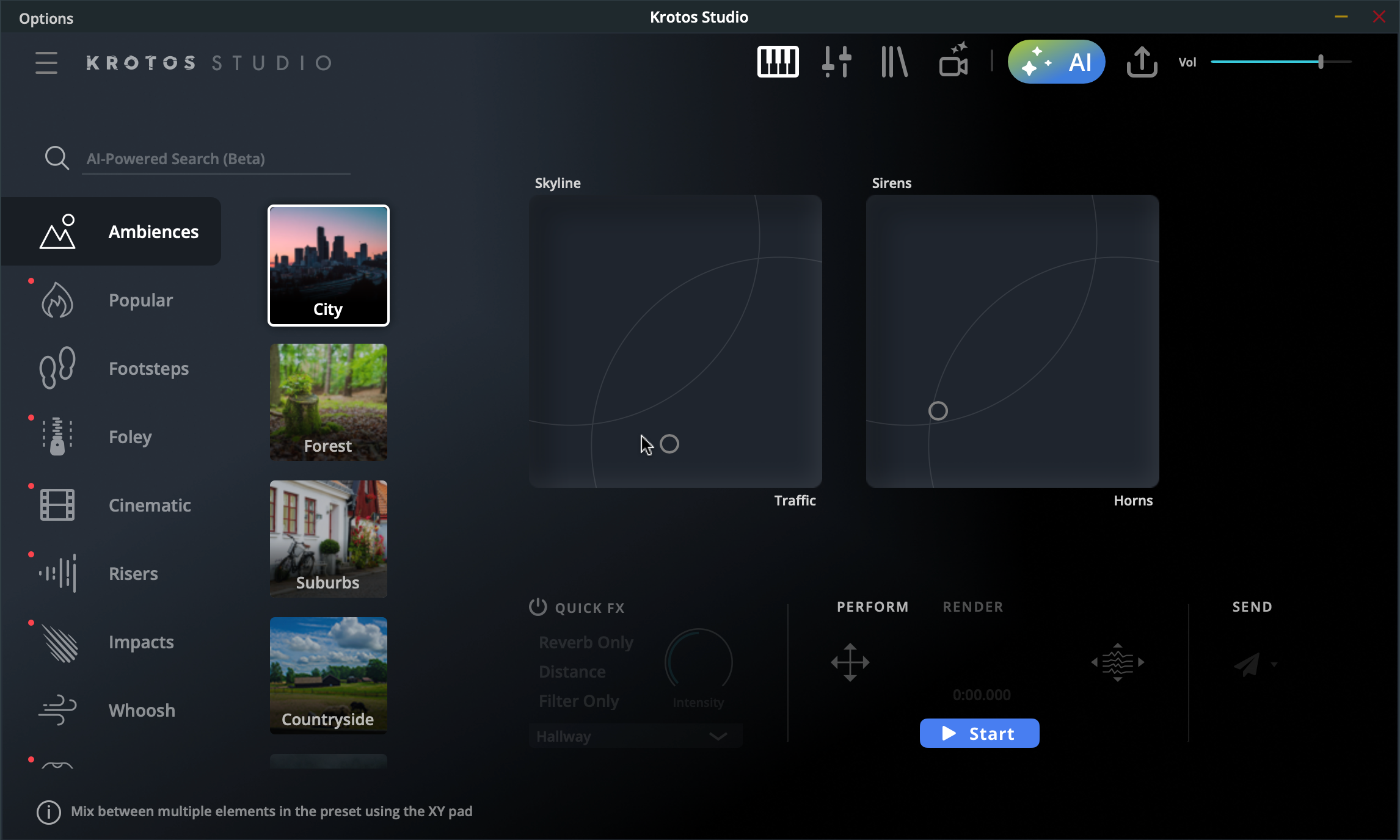
A solution to this is to use VSTs or software that utilises high-quality recordings within its framework, which allows for continuous generation of atmospheres or iterations of the same sound, such as our very own Krotos Studio. The aim of the game is to create custom, for-the-purpose sounds that are repeatable and fully bespoke to whatever duration that works within your project. A more specific example of this would be Weaponiser, which allows you to layer and modulate audio quickly and easily in real time, allowing for your perfect gunshot or sci-fi sound to be repeatable and tweakable without exhausting your sound banks.
3. Ethical AI Integration could Assist Your Work
AI has certainly become THE buzzword for technology companies over the last few years, seen by its integration into everything from fridges to televisions. With the onset of generative AI destabilising the creator economy at large and being embraced by industry giants such as Coca-Cola, jobs that would have required a massive team of people only a few years ago can now be done with minimal effort and even less investment.
Understandably, AI’s use has generated a lot of pushback from creatives who feel their work is being ravenously devoured by plagiarism machines for seemingly no tangible benefit to themselves or society at large.
We want to make clear that we do not use generative AI here at Krotos, and have no intention of replacing sound designers with AI. Our own models are trained entirely on our own material and doesn’t analyse user data in any way to enrich itself. Our aim for AI is for it to act as an assistant, minimising time wasted searching for specific sounds and focusing on the important creative decisions that are the heart of sound design as an art form.
For further clarification, please read our statement on AI.
4. The Old and the New Can Go Together
The key idea we are trying to hit home with this article is that there is no need to limit yourself when it comes to working as a sound designer in the modern era, and that goes for both old and new techniques. We now have access to so many resources that you can make do with almost any setup in almost any environment, but this increase in speed and efficiency shouldn’t mean every step in the process should be the same level of effort.
Time gained through using a tool such as the city ambient preset in Krotos studio should allow you to experiment more with the unique aspects of your sound design. Try out those electroacoustic experiments you have been planning for the psychedelic trip sequence. Why not record those real-world elements that will tie that fight sequence together? Experimentation is the most fun part of sound design, and all it takes is curiosity and time.
Use what is at your disposal to create something unique. If everyone starts using the same sounds and tools for all the same jobs, then why did we ever stop using the legacy sound packs that everyone already recognises? Sound design may usually be ‘invisible’ to the viewer when it comes to foley footsteps and atmospheric soundscapes, but there is a reason so many sounds from franchises such as Star Wars have become iconic; they simply had never been heard before. So, misuse your fancy software for interesting results, use an old microphone trick, take inspiration from outdated techniques using new tools. Let's hear something new.
