
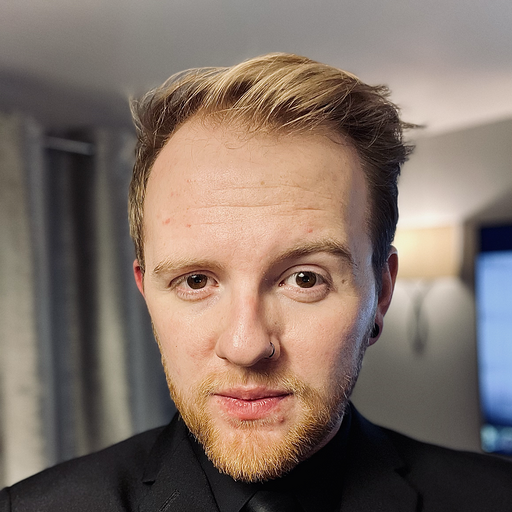
Tell us about Formula. How did the company come about, and how long have you been working in audio?
Formula was founded in 2021 following my background in Audio Engineering at SAE Institute in Milan and professional experience across multiple areas of the audio industry, including game audio, studio production, live sound, technical roles, and artistic projects.
Working closely across very different realities made one thing clear: the audio world is rich in highly skilled technicians and experienced engineers, but it often struggles when it comes to sound design as a communicative and cultural language.
The focus of Formula gradually shifted toward sound design for this reason. Not because of a lack of technical quality or engineering expertise, but because we identified a gap in how sound design was communicated, positioned, and integrated into broader creative processes. There was space for a more intentional approach — where sound could function not only as a technical solution, but as a meaningful expressive element.
Formula was conceived as a platform designed to address audio in a holistic and strategic way, offering creative consultancy alongside production. Over time, sound design became the studio’s core focus, as it represents the point where technical control, aesthetic intention, and narrative sensitivity naturally converge.
Another key motivation behind Formula was the cultural positioning of sound. While technical competence in the audio world is exceptionally high, its communication is often understated or fragmented. Formula operates in that space by bringing clarity, authorship, and a refined visual and conceptual identity to sound — treating it as an integral part of a brand’s cultural expression.
Can you tell us about the Armani project and how your team got involved?
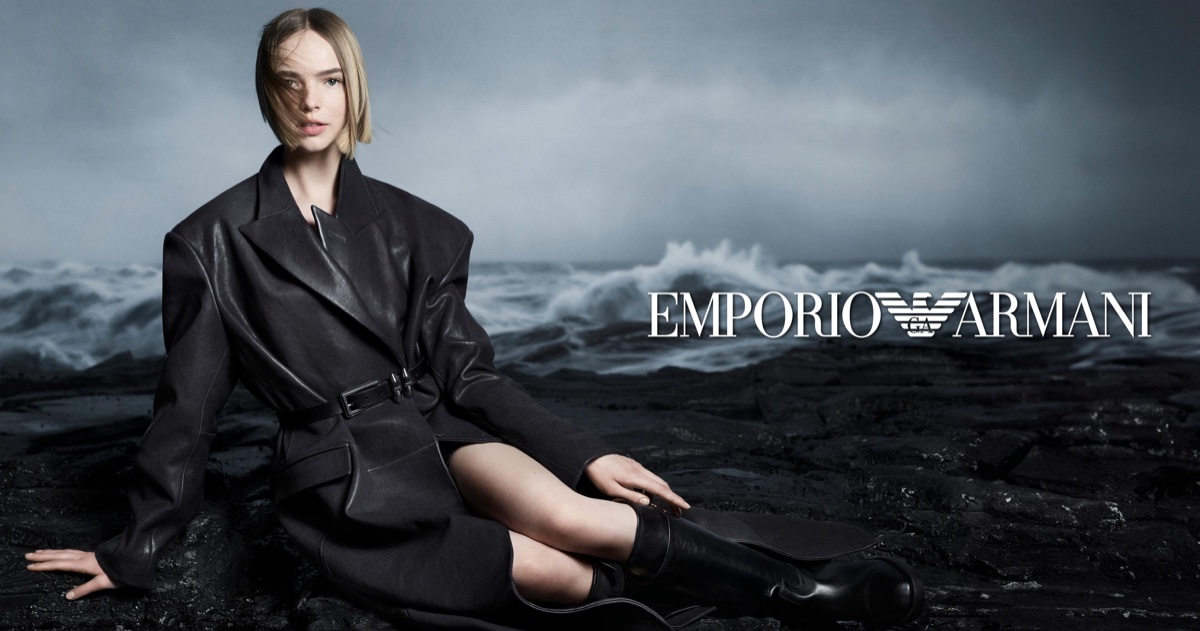
The collaboration with Armani developed through an ongoing creative relationship with director Amedeo Zancarella, a Milan-based filmmaker who trusted Formula from the very beginning. That continuity allowed us to grow together and gradually work on more ambitious projects.
During this process, I also had the chance to collaborate closely with Niccolò Mariani, the art director of the campaign, and there was an immediate creative alignment. That shared sensibility helped define vision, tone, and intent from the early stages.
What was the brief? What story was the clip trying to tell?
The brief was not narrative-driven in a traditional sense. Instead, it focused on atmosphere, physical presence, and materiality.
Sound was not meant to explain the visuals, but to exist alongside them — reinforcing texture, movement, and tension.
Stylistically, we leaned into a raw and minimal form of psychedelic rock that was hypnotic and repetitive, prioritizing mood and physical impact over melody. Tension builds gradually through restraint, reaches a central climax, and then resolves into a more open and spacious musical progression.
Krotos Studio was a key part of this project. How did you discover it?
We were already familiar with Krotos tools, but Krotos Studio became a turning point because of its dynamic and performative approach to sound design. It aligned immediately with our way of thinking about sound as something shaped in motion rather than assembled statically.
I first discovered the software through social media and later had the opportunity to explore it more deeply thanks to a colleague and close friend, Mattia Scarano Montarano. That process made it clear how effectively Krotos optimizes repetitive mechanical tasks, freeing up time and focus for creative decisions.
Where did Krotos Studio fit into your workflow?
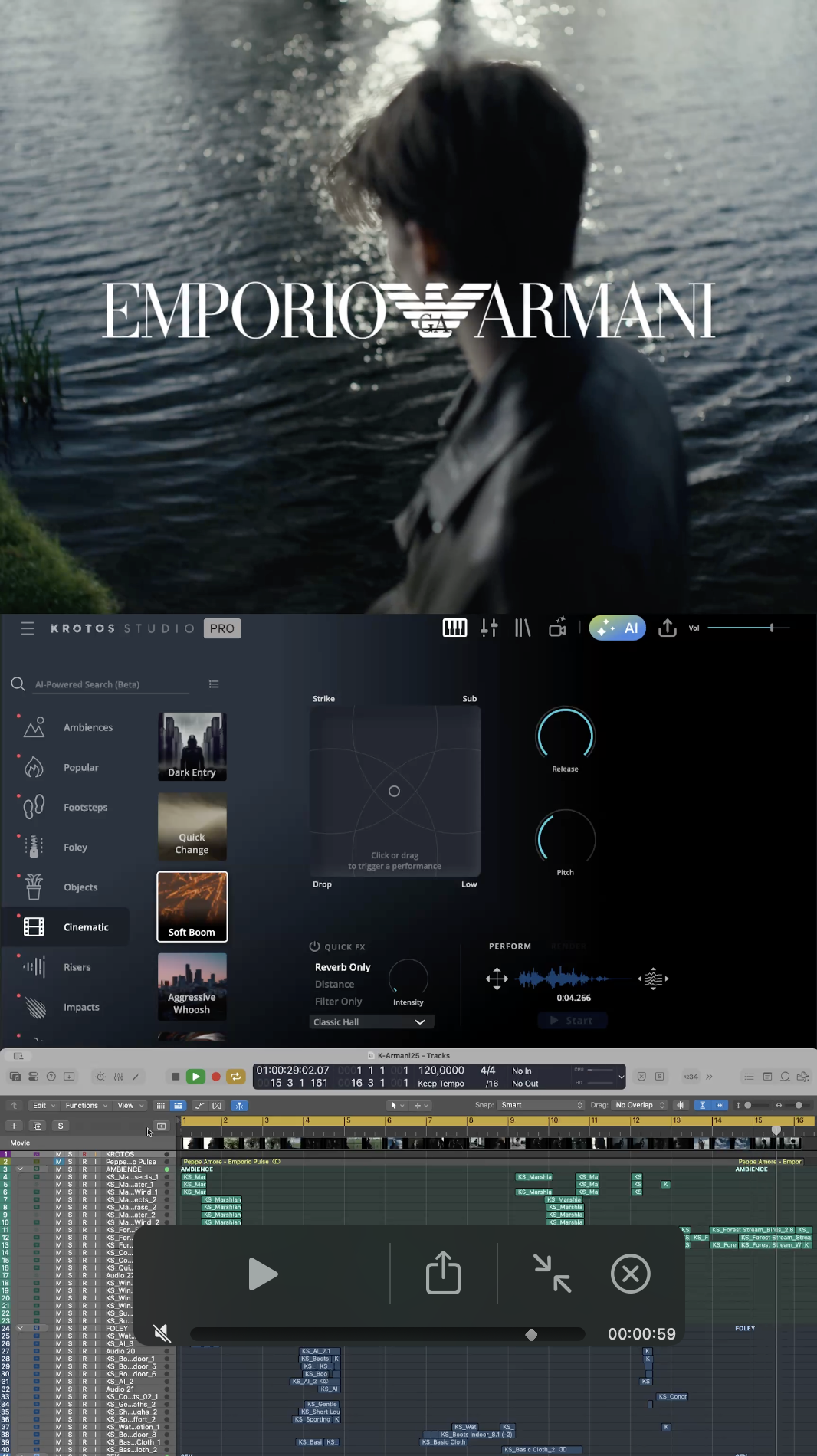
In contemporary video work, sound design increasingly relies on strong foley and sound effect layers, while music often plays a more secondary role in brand and TV content. This is the context in which Krotos Studio fits naturally into our workflow.
I usually begin by defining the atmosphere through environmental sounds, then layering foley elements that range from realistic to more abstract. Krotos Studio proved highly flexible in how sounds can be combined and crafted, allowing me to build and shape layers quickly — especially when working with movement-based elements.
Integrating personal sound libraries was seamless, and the AI-powered sound search significantly reduced the time spent finding the right material. Even the AI tools currently in beta already feel solid and reliable within a professional workflow.
Krotos Studio was used on the Armani campaign, but more importantly, it is now a core part of our everyday working process. It is not tied to a specific collaboration, but to the way we approach sound design across all projects.
It does not generate creative ideas, but it provides the right framework for precise and performative sound synchronization — allowing sound to respond to movement and timing rather than being treated as a static layer.
Overall, it enables a fast, controlled, and highly responsive workflow directly in session.
Were there particular aspects of the workflow that were especially useful?
One aspect that stood out was how it transformed my approach to footsteps and movement-based foley.
Footsteps are traditionally time-consuming and difficult to synchronize convincingly with body movement and clothing. With Krotos, that process became far more fluid and engaging.
Being able to shape footsteps, cloth, and object interactions together in real time preserved rhythm and physicality — significantly improving both speed and creative focus.
What were the biggest advantages compared to traditional tools or libraries?
The main advantages were speed, control, and sound quality.
Krotos made the workflow faster and more efficient — particularly for dynamic and movement-based sounds — while reducing the need for corrective work later in the process. It allowed us to move quickly without compromising impact.
What was the most challenging part of this clip?
Restraint.
When sounds can be created very quickly, the challenge becomes knowing when to stop. In luxury branding, every sound must earn its place — anything unnecessary immediately becomes noise.
How did you approach aligning the sound with Armani’s brand identity?
The fashion context reshaped our approach to sound design. With a brand like Armani, emotional impact must come from nuance and detail rather than volume or excess.
Armani has a clearly defined identity. We were given creative freedom, but always within precise boundaries.
The goal was to create a musical language capable of evoking specific emotions, supported by extremely realistic foley. Sound effects were used sparingly — adding subtle accents and overall dynamic movement without dominating the soundscape.
Were there any unexpected creative “happy accidents”?
Yes.
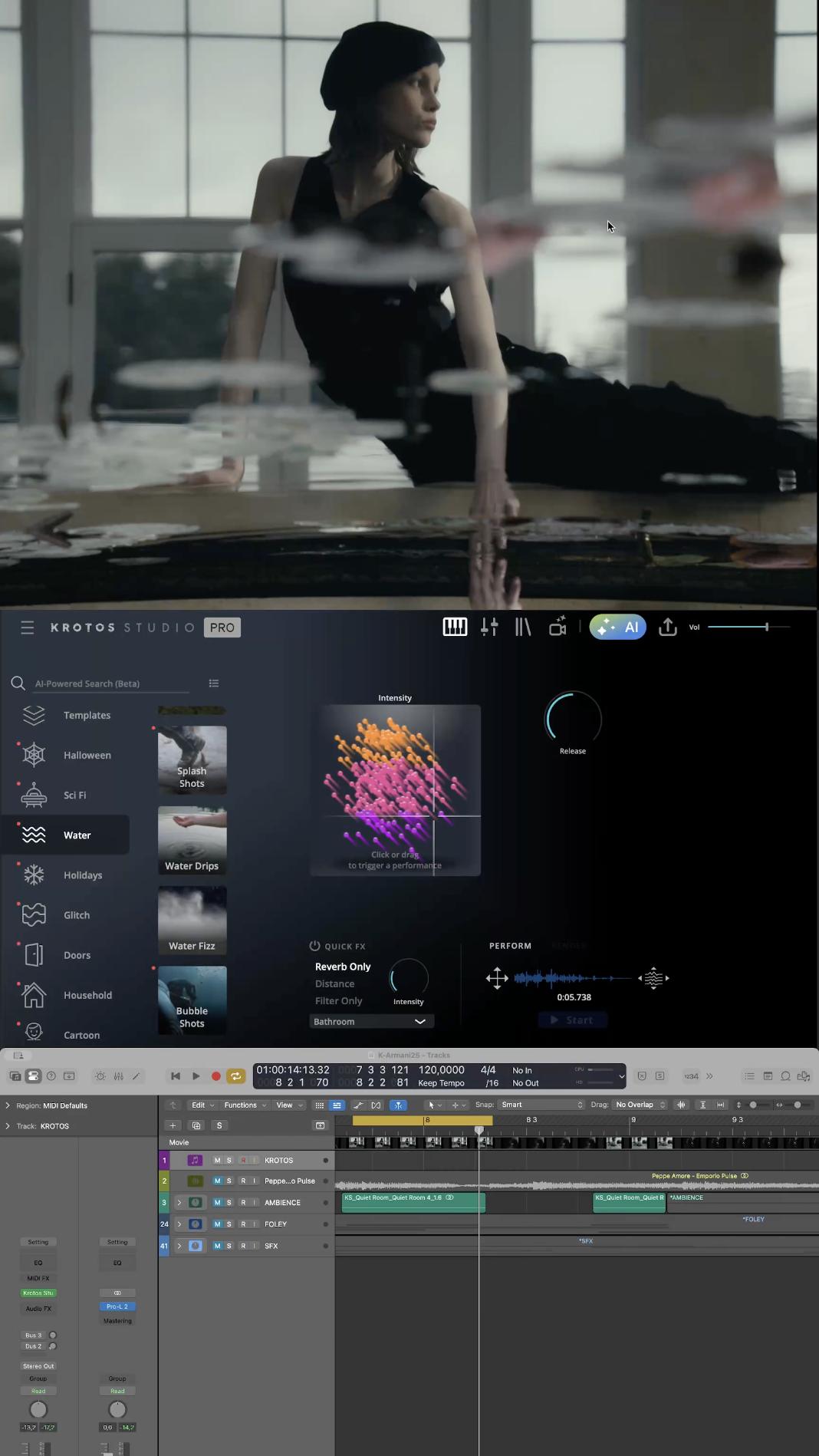
The speed of experimentation — especially in cinematic sound design and foley — led to the discovery of textures and impacts that felt more organic and physical than initially planned.
These moments became some of the strongest elements in the final piece.
If you were to do this project again, what would you change?
We would integrate sound earlier in the creative process. Projects like this benefit when sound and image evolve together from the beginning.
What would you recommend to other sound designers working on similar projects?
Understand the brand before designing a single sound.
Use tools to execute taste rather than define it.
Minimal sound design requires discipline, control, and intention.
What did you learn from this project?
This project reinforced the importance of dynamic, performance-based sound design — particularly for cinematic, foley, and sound effect work in fashion and branded content.
Do you have a favorite moment from the project?
Some of my favorite moments are those where Krotos added subtle physicality to the cinematic and foley elements — small movements and textures that elevate the scene without drawing attention to themselves.
While I approach music differently, Krotos proved extremely effective for cinematic sound design, foley, and sound effects. Coming from an electronic music background, I found that its drone and mechanical foley banks translate naturally into hypnotic, techno-oriented atmospheres that sit between sound design and music.
Most viewers will not consciously notice these details — but without them, the piece would not feel the same.
